Archives for posts with tag: illustration

Over lunch of schnaps, herring, paté and beer, Karen tells Gill about her childhood. Gill’s, that is. Karen was the au pair for her family 50 years ago, and has many stories to tell about Life with the Lipsons, most of them new to Gill. Karen met Peter, her husband, in London then. He was a Danish cabinet-maker working over here, and they’ve been together ever since. Guests at their home near Faaborg, south-west Fyn, we are treated handsomely, shown the countryside and town, and plied with exquisite food and drink. And Gill’s early life.

After cabinet-making, Peter became a designer and architect, and inventor. In his studio and workshop he shows us some of his ideas and products: a hair-treatment hood (hundreds of them, boxed and ready to go); a vacuum-pillow for radiology treatment; a wood-and-magnet, er, thing, that rolls around inside cows’ stomachs and collects all the bits of metal that they swallow with their grass; a simple sprung clip that stops your walking stick from sliding over onto the floor; a calf-feeding tube, a cat-pill-squirter, a pig-inseminator….

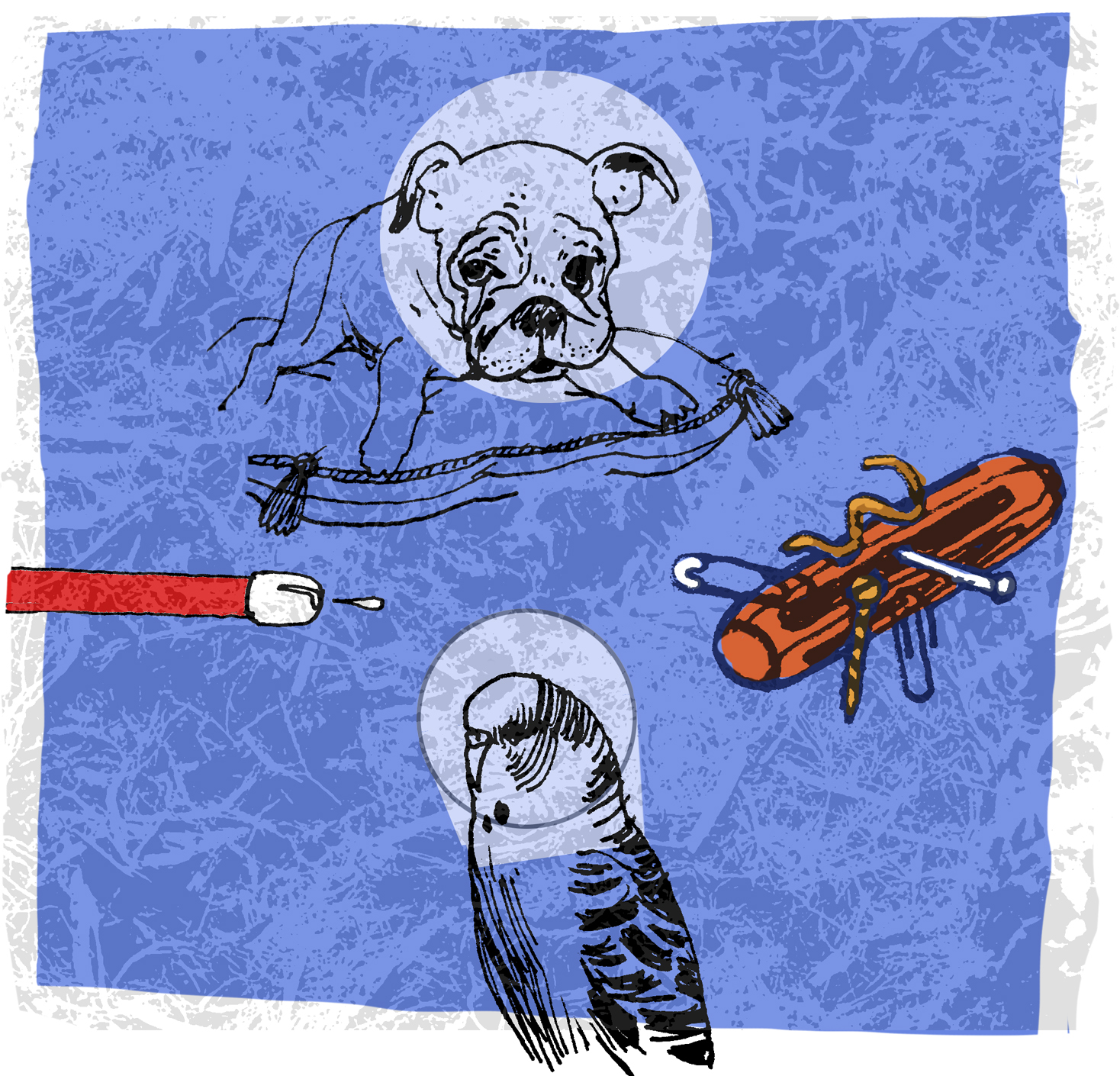
But his invention that even I (no great animal-lover) know already – though, sorry, it still makes me laugh – is the lampshade pet-collar, that stops animals from licking biting chewing fiddling with their dressings. Cats, dogs, rabbits, budgies the world over wear them (not fish or snakes though. But I like the idea of, say, a rhinoceros wearing one). Without a hang-dog face looking piteously out, I take this design seriously…

In Copenhagen I’m in the Design Centre, in the exhibition Hello Materials. There’s an alternative plastic made from fish-scales, artificial bone-growth material, floor-coverings made from recycled trainers, paint that lights up on your skin, soft stuff that goes hard on impact… exciting, cutting-edge, sustainable materials from the world’s scientists, inventors and designers.
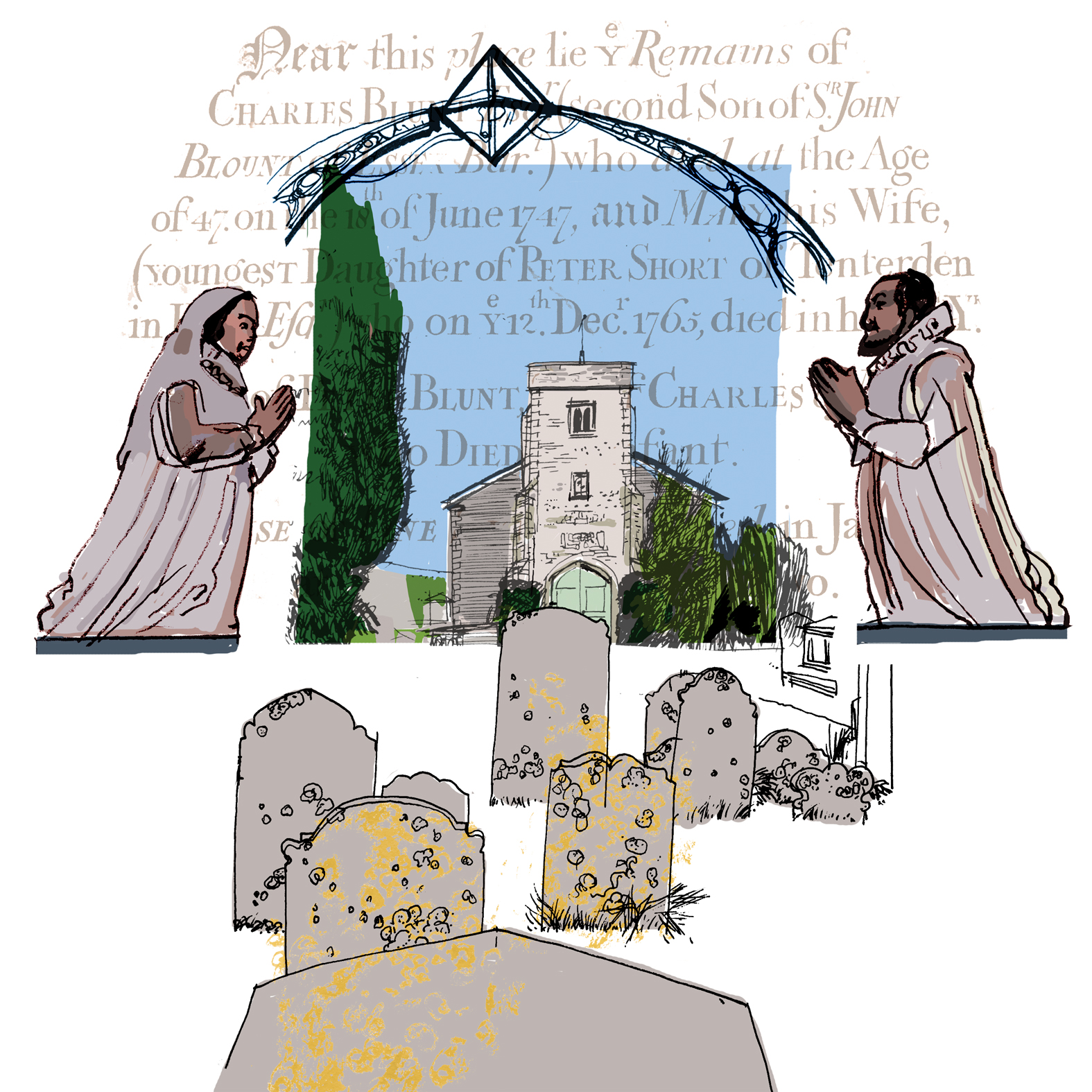
The cold of the grave creeping into my buttocks, a pigeon calling, a blackbird singing: I’m in the shade of a solid dark yew in the All Saints churchyard, drawing the sunlit gravestones in front of me. Many of the inscriptions have disappeared, they’re so old, and they’ve become an installation that is more sculptural than commemorative. That’s appropriate, too: the church of All Saints (first mentioned in 1148) has been an arts centre since 1980. And I declare an interest: over the years I’ve played in bands on this stage, had a birthday party here, helped set up the Lewes Junior Film Club adventures here, watched films from its utilitarian seats, drawn it, photographed it, and swept up in it many many times. I love the place.

Inside it’s plain, except for the ornate memorials to the benefactors of the Parish, the great and the good of their times. Iohn and Iane (where I=J) Stansfield – ‘of the Cliffe nere Lewis’ – face each other, kneeling, and separated by their plaque; painted face cracked and dark with age, Iane regards her husband suspiciously, eyebrows raised over divergent eyes. He’s a Gent., though, who ‘hopefvlly ended his mortall life’ in 1626. Iane ‘his deere wife’ died 24 years later.

The sound of the organ drifts through the empty place – above the stage, in an orange glow, a bowed figure playing is half obscured by the deep dark drapes. In the back hall, the mirrors reflect the sinister looping trapeze ropes hoisted up into the high ceiling.

In All Saints there’s salsa, can-can, ska, capoeira, film, drumming, the Oyster café, blues, comedy courses, zumba, art workshops, a toy library, theatre, Nature’s Rhythms… Iohn and Iane had no idea that the All Saints church would become such a lively and creative place. And ‘hopefvlly’ – that’s how we should live.

In from the biting wind along Euston Road, up steps, bags searched, and into a stylish café at the Wellcome Collection. Apart from the café (‘Please relate your wi-fi usage to your intake of food and drink’ – to paraphrase the notice), here’s a bookshop, library, and permanent and temporary exhibitions. The museum aims to explore ‘ideas about the connections between medicine, life and art… The Wellcome Trust is the world’s largest independent charitable foundation funding research into human and animal health’. Great cakes, too.

Downstairs there are two exhibitions. ‘Charmed Life’ features charms and amulets from the Wellcome Collection, beautifully arranged in flowing shapes by artist Felicity Powell, and juxtaposed with her own wax artworks. From tiny wooden shoes to a nail-studded sheep’s heart, a vertebra carved with a face, animal teeth, lockets, stones, they bear witness to the significance of the object in people’s lives.

And here’s an exhibition of Mexican Miracle Paintings. If you were, say, falling to your death from a roof, or about to be shot, you might pray to the Virgen de Zapopan to save you, or to San Francisco de Asis, for instance. Then, if you survived, you would probably want to commission a small painting or ex-voto to dedicate to the Virgen or San Francisco in thanks. So here are walls full of these miraculous paintings, mostly on tin roof tiles, showing the disaster and the deliverer, and the carefully and often beautifully inscribed story.

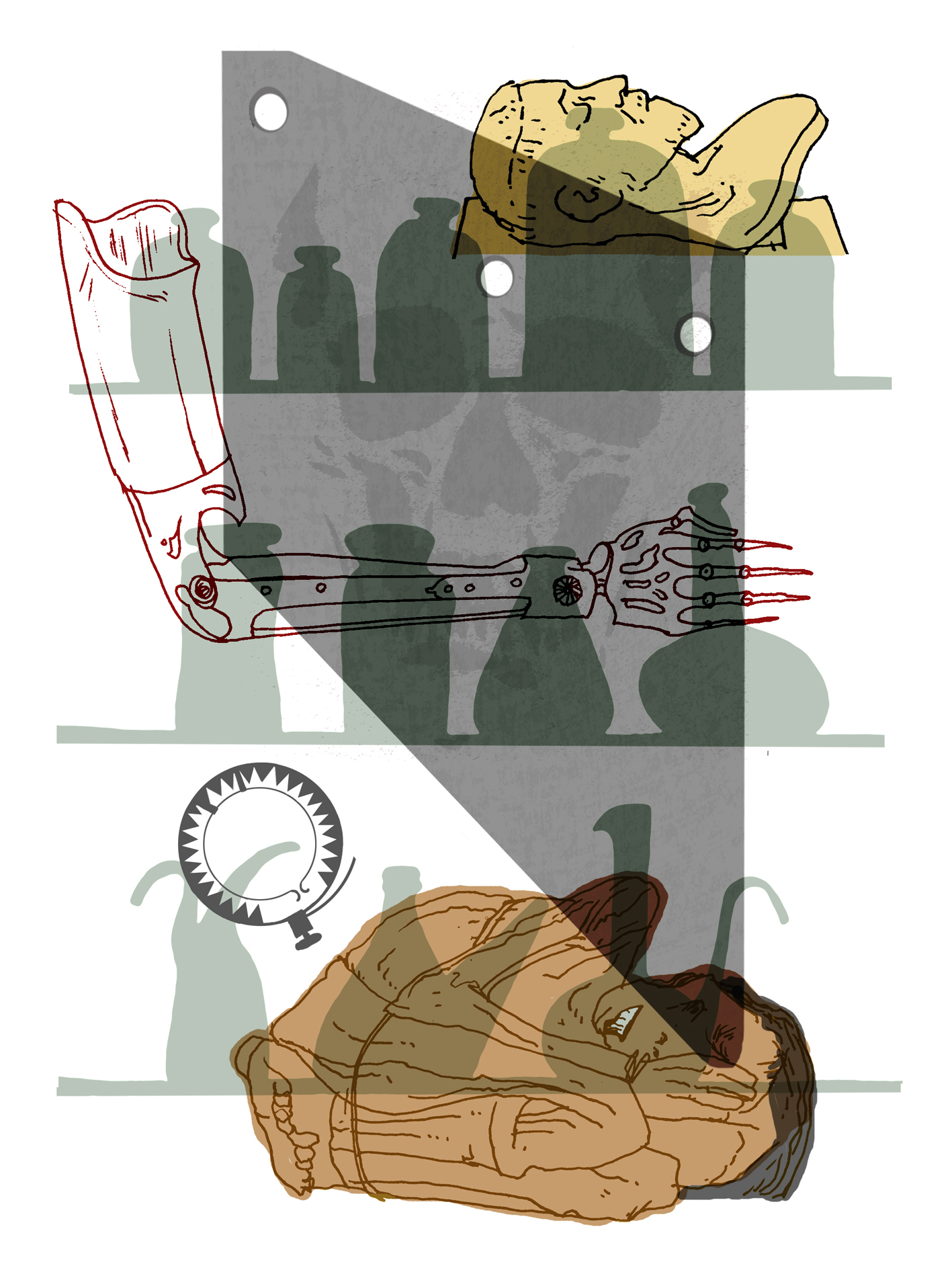
Upstairs: the Collection – well, some of it. There are a number of prosthetic limbs, from earlier centuries, some exquisitely engineered, with independently movable joints and fingers. Here’s Disraeli’s death mask, a shrunken head, a whole mummified body from Peru, buried with ritual amulets; shelves of lovely glass flasks for various body functions; a shocking Chinese torture chair made almost entirely of edge-mounted sword blades, and Darwin’s walking canes. And this metal rhombus thing? The caption states simply: ‘Guillotine blade, French, 1792-1796’.

And what looks like a spiky jubilee clip with a small cycle clip inside? It’s a Victorian anti-masturbation device. Your Wellcome.

http://www.wellcomecollection.org

http://www.michaelmunday.co.uk

Sun slotting in through venetian blinds: I get up and shower. Aching from a day’s humping of gravel bags, digging, planting, easing Arthur into his hole (see previous post), we’re going to spend this last golden day cycling. At the station we can just get the three bikes between standing passengers in a 2-car train: the woman in a wheelchair could squeeze between us to the toilet, if it was working.

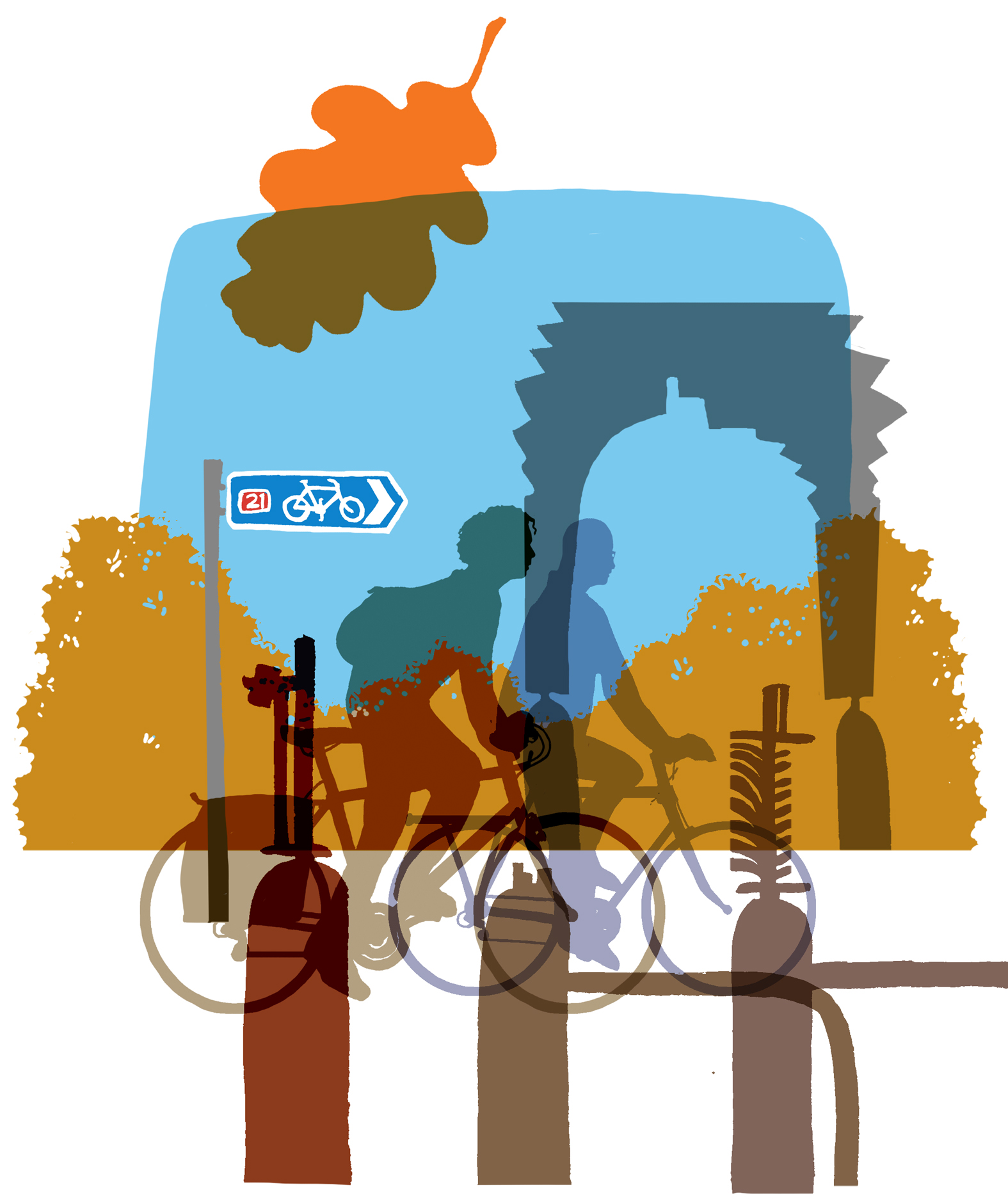
It’s a relief to burst out at Polegate, and finally we find the Cuckoo Trail: an 11-mile cycle and walking path that once was the Polegate to Eridge railway line, torn up in 1968. It’s a lovely ride between the big oaks, still with their leaves on. And it’s not strenuous, I’m glad to find! We come to junctions with other paths and roads, gateways that are really unusual: bullet-nosed bollards with a simple cast iron shape on top, or a big serrated steel arch, imaginatively-wrought – it’s a sculpture path as well. It’s a beautiful day, warm too: we eat our Co-op sandwiches sitting on a bank, looking at the gradated layers of landscape stretching back towards Firle Beacon.

We’re aiming for the 4.02 back to Lewes, but we’re a bit tired now and miss it, so have a pint of Old in the pub (also tired). Cycling the 100 yards to the station, we’re separated by the crossing barriers rattling down between us: I wait obediently till I realise that it’s our train. Pedal furiously towards the footbridge, hoist my bike onto my shoulder, and leap up the steps into the crowd coming down. At which point my perfect day becomes, well, less-than. My ankle turns over and I go sprawling across the steps, bike clattering, and the crowd parts around me, avoiding eye-contact. Battered and wincing, I lurch across the bridge dragging the Ridgeback, but it’s too late – our train pulls out. I curse that pub’s dreary embrace. Apart from that, though…