Archives for category: Uncategorized

DLWPAV

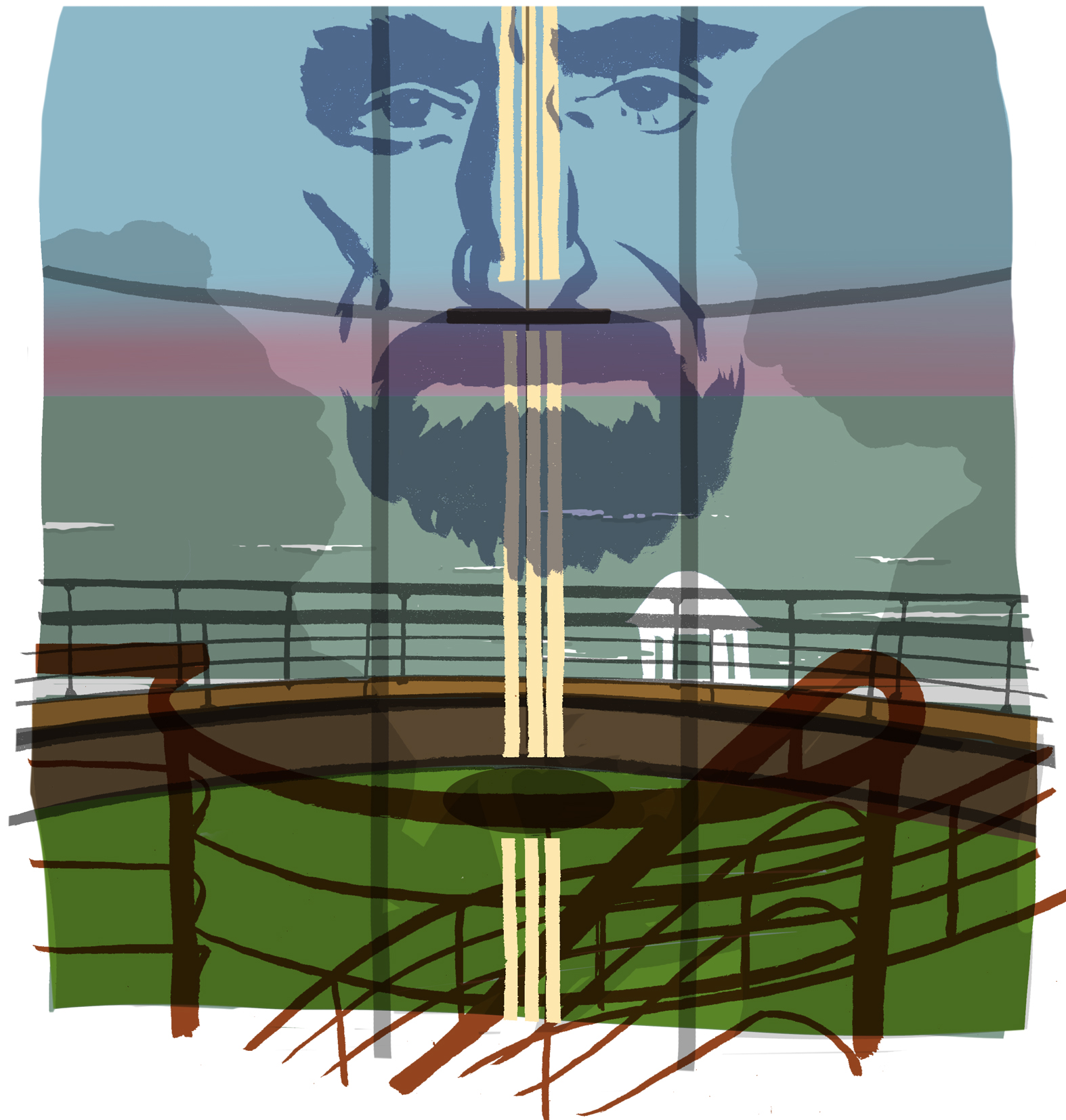
A rosy dusk outside the De La Warr Pavilion’s stairwell. The camera swings in slow-motion side to side across the curved banister, and outside on the balcony, elderly couples waltz gracefully to Schubert’s Nocturne in E Major. It’s a beautiful and moving experience. I’m in a large dark gallery, at the De La Warr, and in the middle is a large double-sided screen on which the film is projected. Outside the room is the actual stairwell. And outside that, outside the curved glass, the waves are crashing onto the beach.

It’s part of Breakwell’s exhibition Keep Things As They Are. (The title is taken from his anti-Conservative leafleting campaign Vote Conservative and keep things as they are). It’s also ironic, as his work was experimental and groundbreaking, and he was one of the key members of the British art avant-garde. He was, but died in 2005, shortly before the re-opening of the Pavilion and its first exhibition, which he’d curated. He is mostly known for his Diary, which he started in 1965 and kept for forty years. It takes different forms: collages, photographs, drawings, text and calligraphy, and video.

I am in a small room now, and on each of the four walls is a life-size charcoal drawing of Thelonious Monk in profile, walking in a circle. I put on the headphones and walk in the same direction, round and round, hearing 12 bars of Monk’s Misterioso played over and over, seeing my reflection in the glass of the drawings. I can make the 12 bars last one circuit if I walk slowly.

Finally, I see a text on a wall: 50 Reasons For Getting Out Of Bed – and they are beautiful reasons: …’Lionel Hampton solo on Stardust. Freshly poured pint of Guinness settling on the bar. White butterfly on purple buddleia…’ (It’s shocking that when he finally gets up it is with pain and nausea from his chemotherapy). Inside the dark room is what appears to be a huge photograph of his face, while his rasping voice reflects on his life. After a while you realise that his face is slowly changing. It has changed from baby to its final sunken state.

It’s deeply moving, and you leave the De La Warr with a New Year’s resolution: make every day count. See it if you can: it closes 13 January.
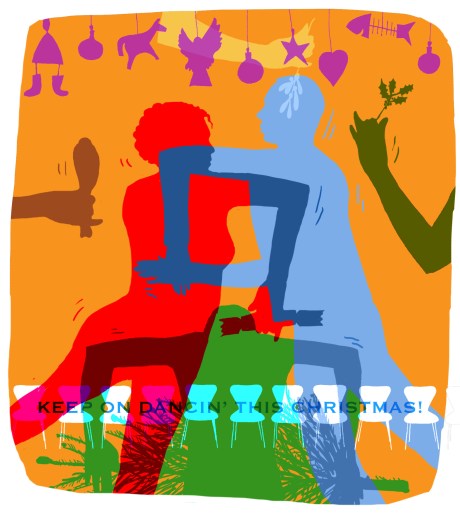
dancin'christmas

Keep on dancing’ at Christmas and into the New Year!

dance-3

From the flooded toilet floor of the Dome’s dressing rooms up to the stage area, it’s a long, cold way. Especially barefoot. Hazardous too: the steps have a metal edge. Cameraman and soundman stand impassively amongst the women changing their costumes, filming interviews. After the last two days of rehearsal, ThreeScore Dance Company are about to go on. Nerves ripple down the lines of us waiting for the doors to open, and for us to file through, finally, to an audience.

We’ve performed Bettina Strickler’s piece before, but in less than ideal conditions. Now, it’s properly lit, in classic ‘black-box’ theatre, and we’ve all come a long way in the conviction (and maybe grace?) of our movements. The group (twenty of us) are intertwined on the stage, ‘breathing’ to the Morricone score, then breaking into the fast klezmer: I and three other men finally co-ordinate our strange feints, and with a ‘Hey!’ – slap back-to-back, sink down, and are pulled off. (You had to be there, really).

Antonia Grove’s piece is complex: four of us play live music at the beginning, building to a crescendo, after bedding down plants in the bank of earth at stage front. Then the company stands in front of our triangular-back chairs, before the strange repetitive sequence begins, in total silence. We stand, then the music starts: ‘Treasures’ by Seasick Steve, and we perform the rituals of caring and tending, waiting for growth: it’s about ‘the emotional relationship that forms with something alive and rooted to the earth.’ Labour and Wait.

Ben Duke’s piece, You Can’t Miss Me, evokes the classic footage of the flood of commuters across London Bridge, leaving one man isolated in the middle: ‘Well – how did I get here?’ His is one story among many – he’s joined (but not joined) by others, also questioning their positions. We attempt to make contact, but ultimately, we’re on our own. We move, slowly, around the stage, surrounded by the richness of Glenn Gould playing Bach, and for me it’s a truly beautiful, euphoric moment. This is the culmination of a year’s work in a parallel life, a life I’d never imagined. Dance.

From the bridge you look over the basin of the River Calder, at a necklace of orange buoys above the weir; on the other side there’s a bizarre cartoon figure, a sort of ten-foot Mr Potato-head, made of ducting, a salt skip, bins and brushes, hanging from a crane. Below it are the barges and narrowboats clustered under the old industrial buildings of Wakefield’s waterfront. The bridge leads us over to to The Hepworth Wakefield, the two-year-old art gallery that houses a stunning collection of Barbara Hepworth’s sculpture, together with works by Henry Moore, both Wakefield-born.

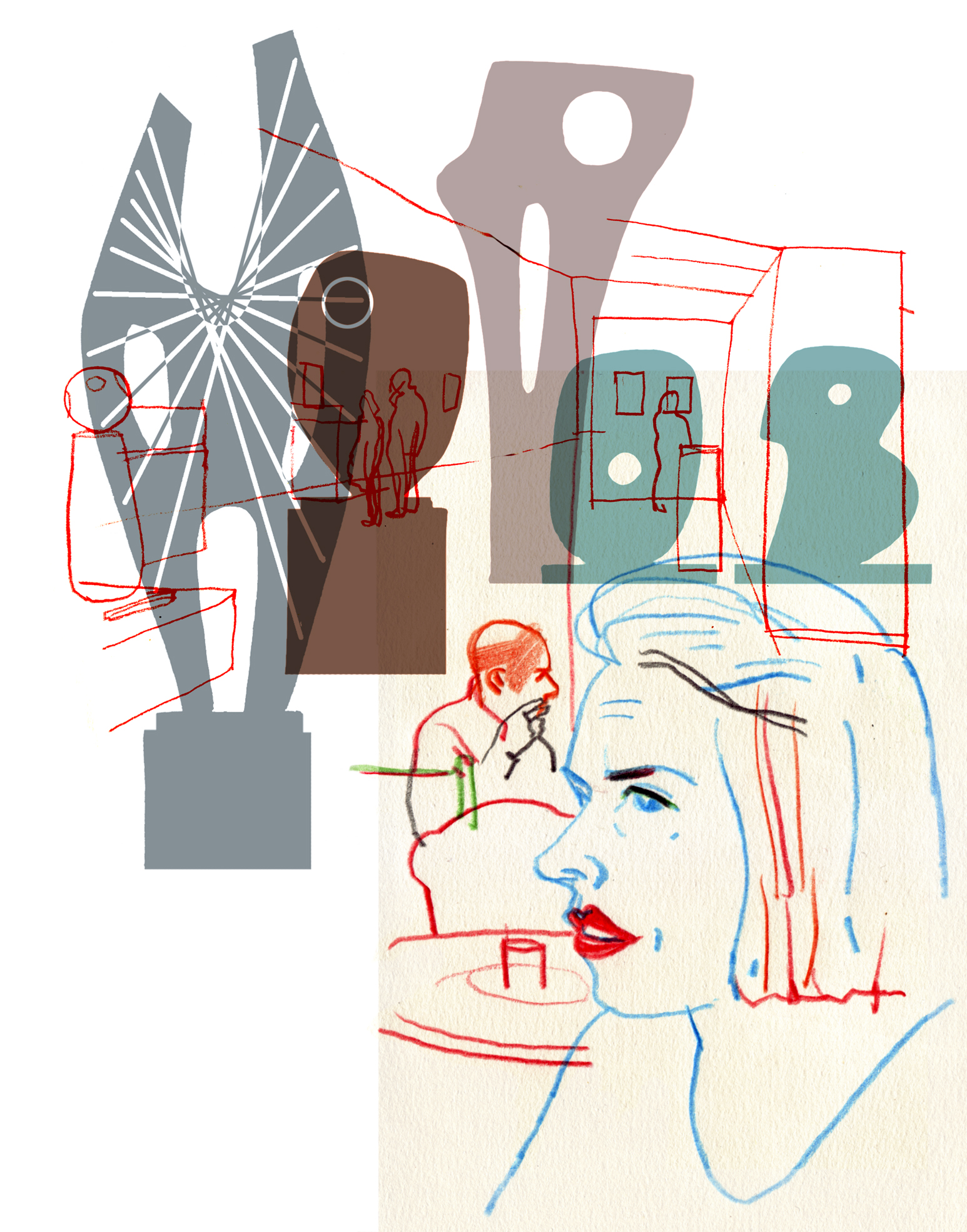
Inside, the picture windows frame the river-bank willows, and the sun casts long shadows across the gallery floor and lights up the familiar Hepworth shapes: curved abstracts, (yes, with holes, in the style beloved of 50’s cartoonists), smooth surfaces contrasting with rough textures. Many of these are her plaster sculptures, and there are drawings and working models: here’s a full-size maquette of the Oxford Street John Lewis ‘Winged Figure’, and small smooth abstract still lifes, large wooden egg-shapes, everywhere surfaces that you want to stroke, and the golden afternoon light pouring in.

In the shop (who can resist a gallery shop?) I buy some coloured pencils. There was a time when they were my chosen medium, and I sit and draw Danielle, and drink a Belgian beer. Art galleries – they always start me up again.

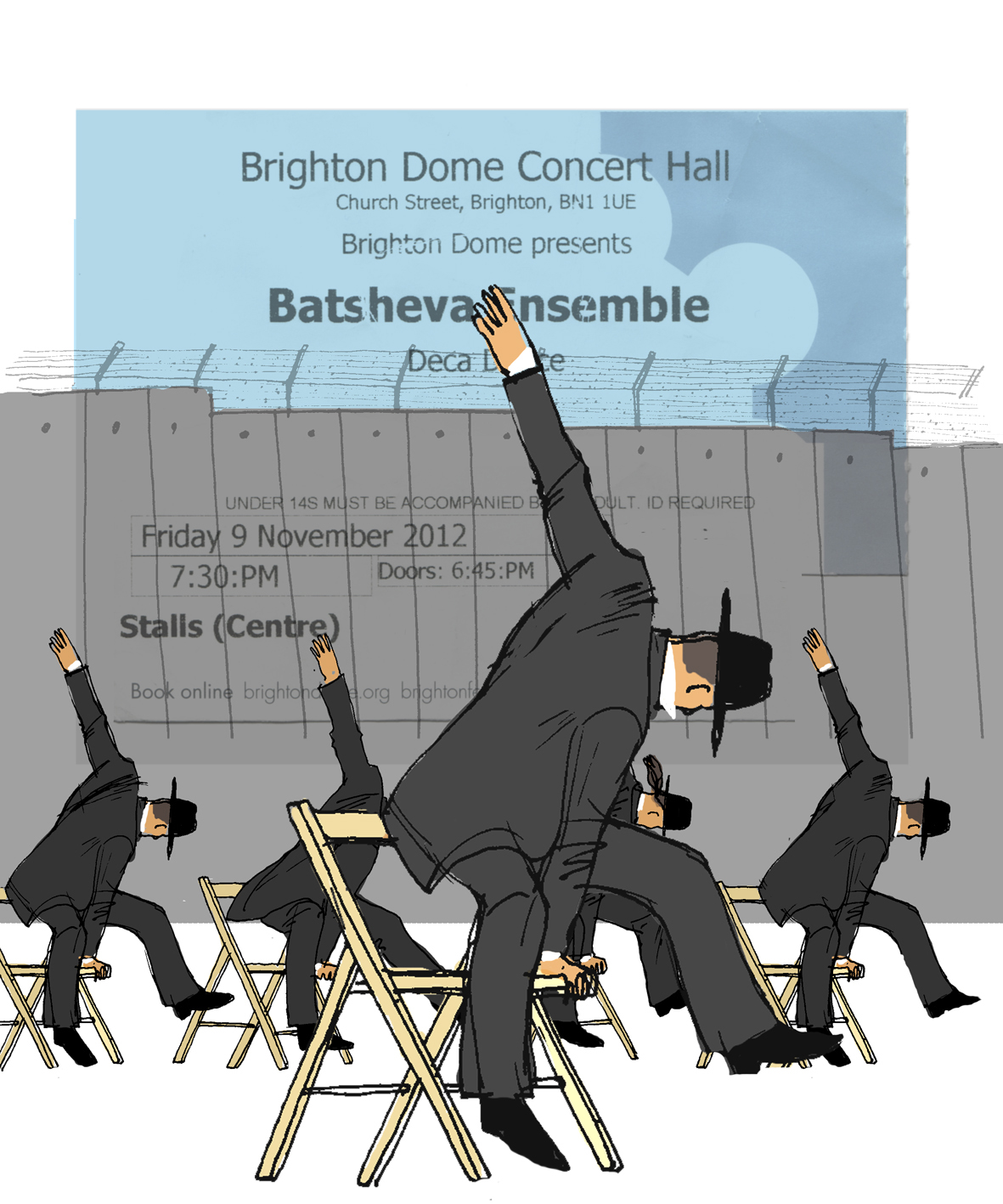
House lights go up, and the bouncers carry the elderly woman, struggling and still shouting, up the aisle and out of the Dome: ‘Free, free Palestine! Free, free….’ The dancers on stage are still, looking straight ahead. The audience clap and cheer. At first I’m not sure if they’re applauding the protest, or the bouncers, or the dancers. The house lights dim and the dancers continue, poise perfect. Batsheva’s young dancers are fantastic and the choreography breathtaking. They come on dressed in Orthodox clothes: black suit, black wide-brimmed hat, open-neck white shirt. And then dance crazily in a most unorthodox style.

‘Free free Palestine! Free…’ house lights up, bouncers move in, applause, two young women carried out. Dancers resume, perfectly. They come down into the audience, advancing kindly yet determinedly, and choose partners to take to the stage. They manage not to choose a protestor, and at the end of this piece there’s a lone couple swaying: a handsome young Israeli dancer being stroked by an elderly woman wearing an Israeli flag-ribbon. The audience love it.

And here’s the problem: Batsheva’s tour is funded by Israel’s  Ministry of Foreign Affairs – their ‘best known global ambassador of Israeli culture’, otherwise known as Brand Israel. This is why people are protesting; art doesn’t exist in a vacuum. In 2009, Arye Mekel of Israel’s MFA said ‘This way you show Israel’s prettier face, so we are not thought of purely in the context of war.’  I’m sure that members of the dance company reject their government’s policies, and their choreographer, Ohad Naharin, has disagreed with his government for years over the Arab-Israeli conflict.

After the standing ovation (richly deserved), there is a Question & Answer session. I step up to the microphone and ask politely of the dancers: ‘Do you understand why people might protest at your performances?’ They look uncomfortable. The chairman quickly replies that that is not a question suitable to this forum. ‘On the contrary, I think it is just the right forum…’ I begin. A bouncer, swiftly at my side, says ‘That is not a question suitable to this forum.’

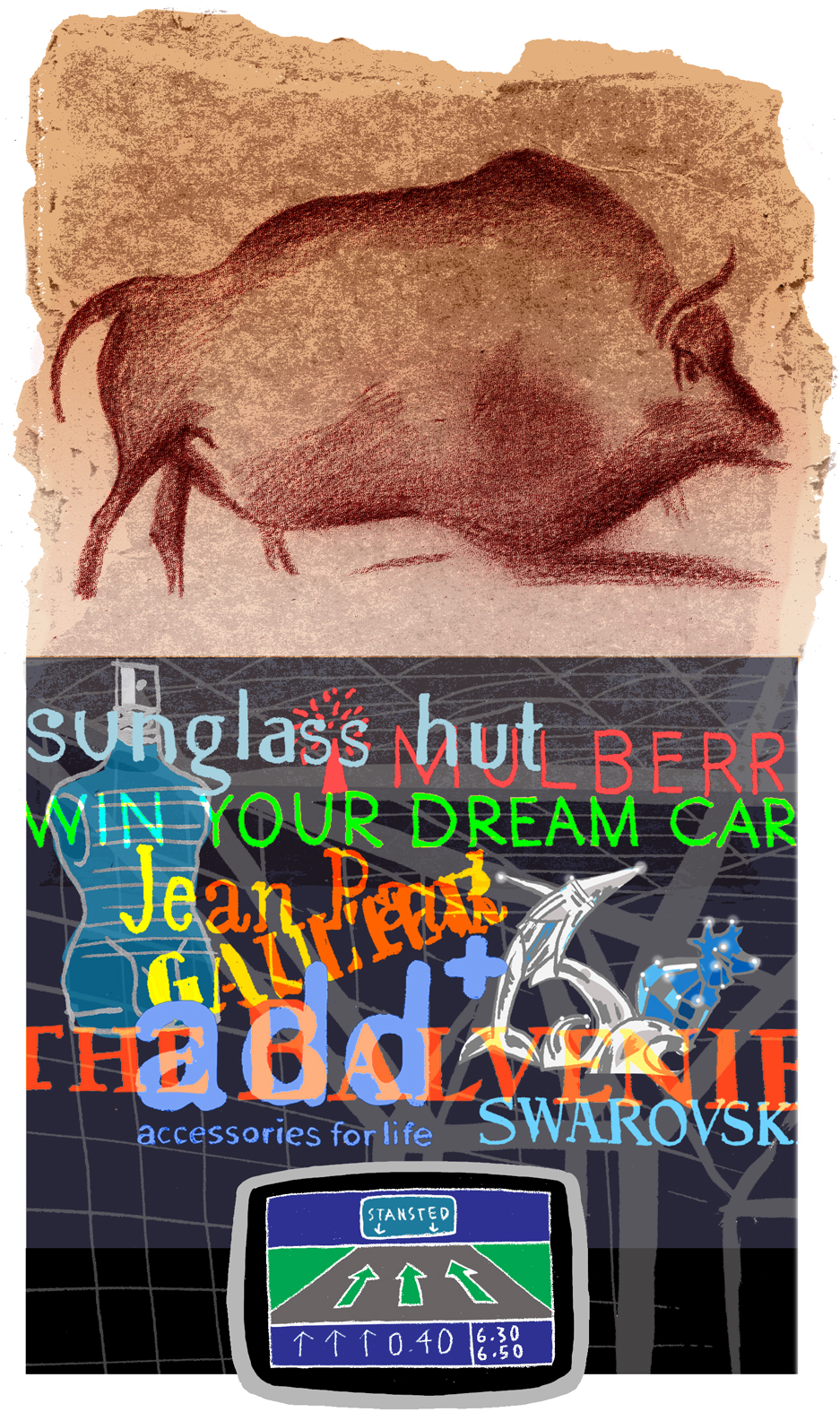
6.30am – satnav bright in the rainy dark – to Stansted Airport, our lanes clear, but incessant headlight stream swarming in to London. Imagine that your job requires you to drive into London every day at 6am; perhaps it does. Stansted Airport: modern world writ large. Huge steel beams frame World of Mammon, thousands of shelves of exquisitely-displayed perfumes clothes phones phone accessories spirits wine scarves ties food… high-gloss images of airbrushed perfect people buyingshoppinglivinglifetothefull: don’t you wish you were? Instead of fretting about the luggage restrictions of Ryanair (1 bag under 10Kg in the cabin – otherwise an extra £25 each way).

The American is dabbing the little wound on his bald head: he was warned about the low roof and the stalactites but immediately walked into one. The cave, though immaculate, still has that deep rich old smell, beyond time. Above us two reindeer are nose-to-nose, painted onto the rock shelf. The standing deer seems to be licking the other’s snout, standing over it, sympathetically, or triumphantly – who knows? A herd of bison stampedes around the walls at head height; the undulating surface of the walls would give body and movement to their forms, especially when lit from below by flame. 17,000 years ago artists were painting these living animals in manganese onto the wall, and they still live.

http://www.hominides.com/html/lieux/grotte-font-de-gaume.php

Sadly, the guest poet had to cancel, and, in a helpful and completely mad moment, I offered to step in. And now I can’t find my glasses as I’m about to read to seventy-odd children and adults, from a book of Basho’s beautiful haiku. It’s another Lewes Junior Film Club event: the films are poignant and very poetic – The Red Balloon and White Mane, both made in the 50’s by Albert Lamorisse. Before the showing, the kids sit at the tables in All Saints, drawing up storyboards (involving Lewes and – yes – a red balloon) and now (when it comes to it) I suddenly get nervous. I read a couple of haiku that I made up; we’re to make some up together on a big smeary white board.

Once on the Kisoji trail in Japan I stepped on a snake (apart from snakes and bears, there are very sophisticated toilets on the trail) so I tell them this:

Scared by a snake on the path–
How comforting is a warmed
toilet seat!

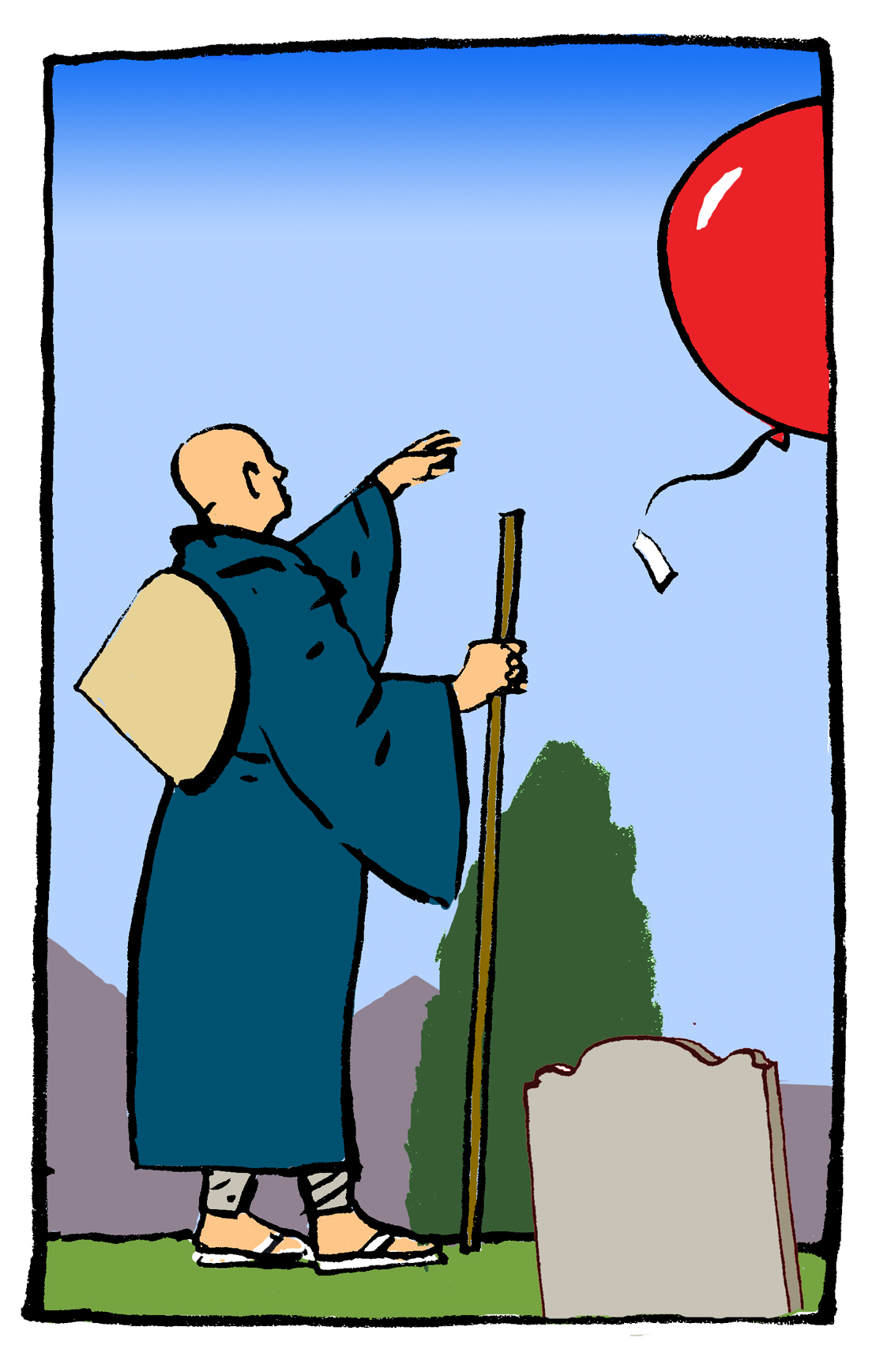
which gets a bit of a laugh. After the first film, the kids write messages on tickets hanging from a great cluster of red balloons, and then burst out into the sun in All Saints’ churchyard to launch them.

Silent stone walls.
Then a squeaking red eruption
Up! go the balloons

but

One red balloon
Drifts along the golden street
Looking for an owner

(Disclaimer:
Seventeen syllables do not
a haiku make–
Necessarily)

Stomach cramps. It’s nearly two weeks since they started, and despite a couple of trips to the doctor, I still don’t know what it is… No, I’m not going into detail. But I’m fed up, and I’m going to stay in bed today. With the sun slanting across the wall, I reach for my well-thumbed Bleak House. And start thinking: ” Am I staying in bed because of the stomach? or is it to read Bleak House?” Work’s quiet at the moment, so there’s no pressure to be in the studio, but there’s still a sub-stratum of guilt, which is easily buried by the next twinge. Just how self-indulgent am I being? This is the omni-present question for the free-lance designer/illustrator, in more ways then one.

Young Smallweed sidles off the page, in imitation of his role model, Mr Guppy. They’re practically in the room with me, these two strange characters: Small-,  or ‘Chick’ Weed – fifteen going on fifty, his little weazen features protruding from under the tallest of hats, walks at the same angle as his hero. The tender chords of Guppy’s heart vibrate in yearning for Esther, the narrator, (though they may be also stirred by the possibility of a noble family connection). Grandfather Smallweed, grasping loanshark, sits in his box-chair, his little legs hanging uselessly over a drawer of reputedly fabulous property. From time to time he violently throws his cushion at his wife opposite, and slumps down, ‘like a broken puppet’. Judy, his wizened granddaughter, has to punch and shake him back up. The Smallweed family “has no child born to it, and that the complete little men and women whom it has produced, have been observed to bear a likeness to old monkeys with something depressing on their minds”.

I love Dickens’ characters (though Esther, unloved and abused as a child, lets you know just how wonderful she is thought by those around her). I’m living in a world of shocking inequality, hypocrisy, greed, and fear. I’ll need a cup of tea in a minute.

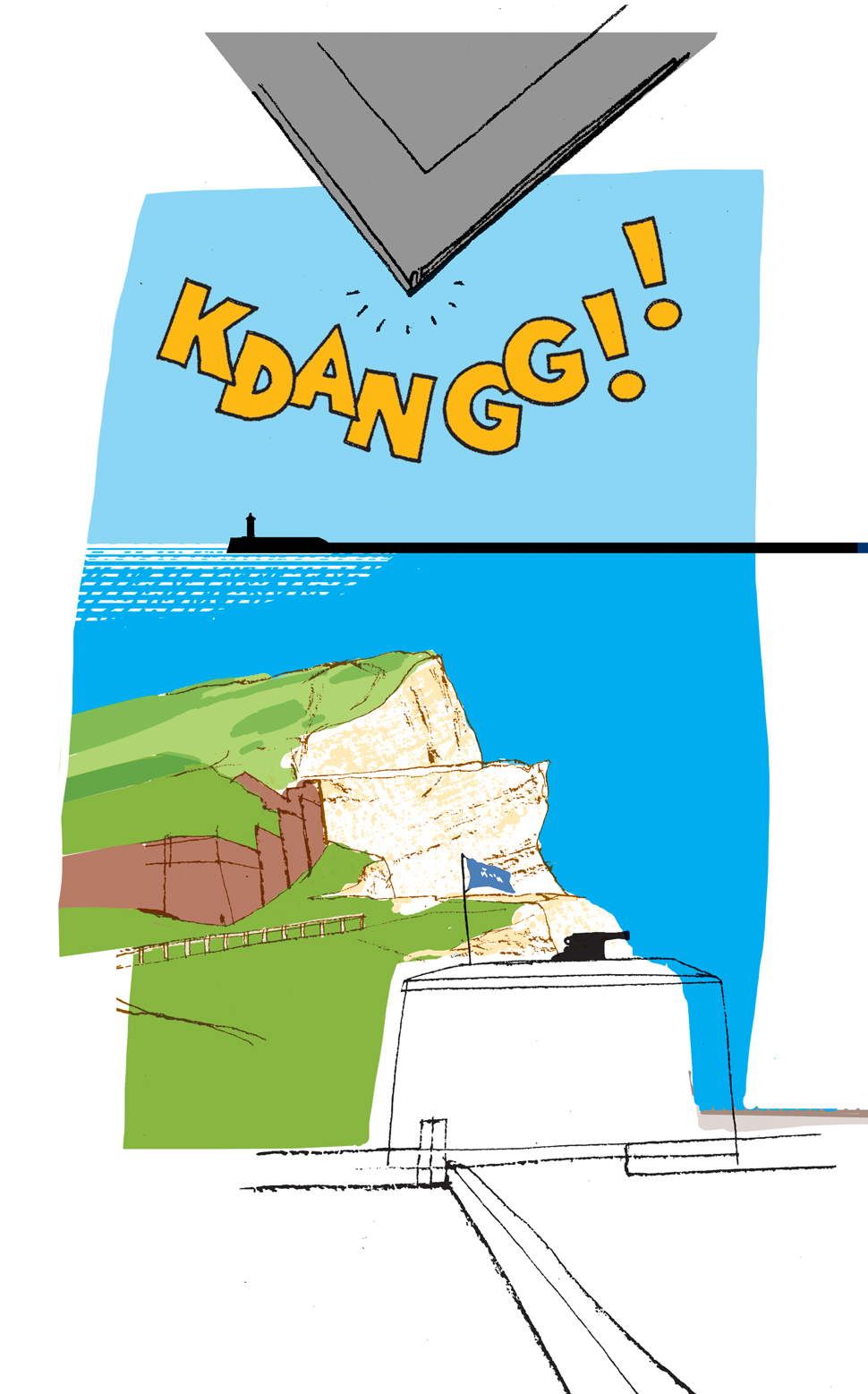
KDANGG is the sound of the garage door connecting with my forehead, in no uncertain terms. The sharp blow forces out a loud and vile oath, and I sink to the forecourt, moaning. Gill, sensitively, keeps well clear and silent, though in retrospect I think I would have preferred being smothered in sudden and huge sympathy.

The plan was to cycle along the seafront, though this could be postponed now, due to my life-threatening concussion. I sit on the concrete, staring. But it’s a golden warm autumnal day; it would be a shame to waste it in A&E, queuing for hours with railing-trapped children and drunks with axes in their heads.

So to Lewes Station and a train to Newhaven (this is not an endurance test). We take the cycle path that goes through the nature reserve and turn off at Tidemills, an old ruined mill and village, once home to 100 workers. The last residents were forcibly removed in 1939. From the beach you see the long black arm of Newhaven Harbour, lighthouse at the end silhouetted against a blue sky and glittering sea. Tiny figures climb the steps onto the harbour wall, only to be repulsed by barbed wire.

We cycle along the promenade towards Seaford Head, and stop at a little kiosk; it serves good espresso and has a blackboard, saying: ‘Frankies Forecast. Dry, Bright, Sunny, Clear & Warm. Light Gentle Breeze From the SW Gently Lapping Waves Carressing The Shoreline With A Welcoming Embrace…’

A little further we pass a bench with the inscription ‘Glad and Ron Wellden, now dancing together always in the hearts of those who love you.’

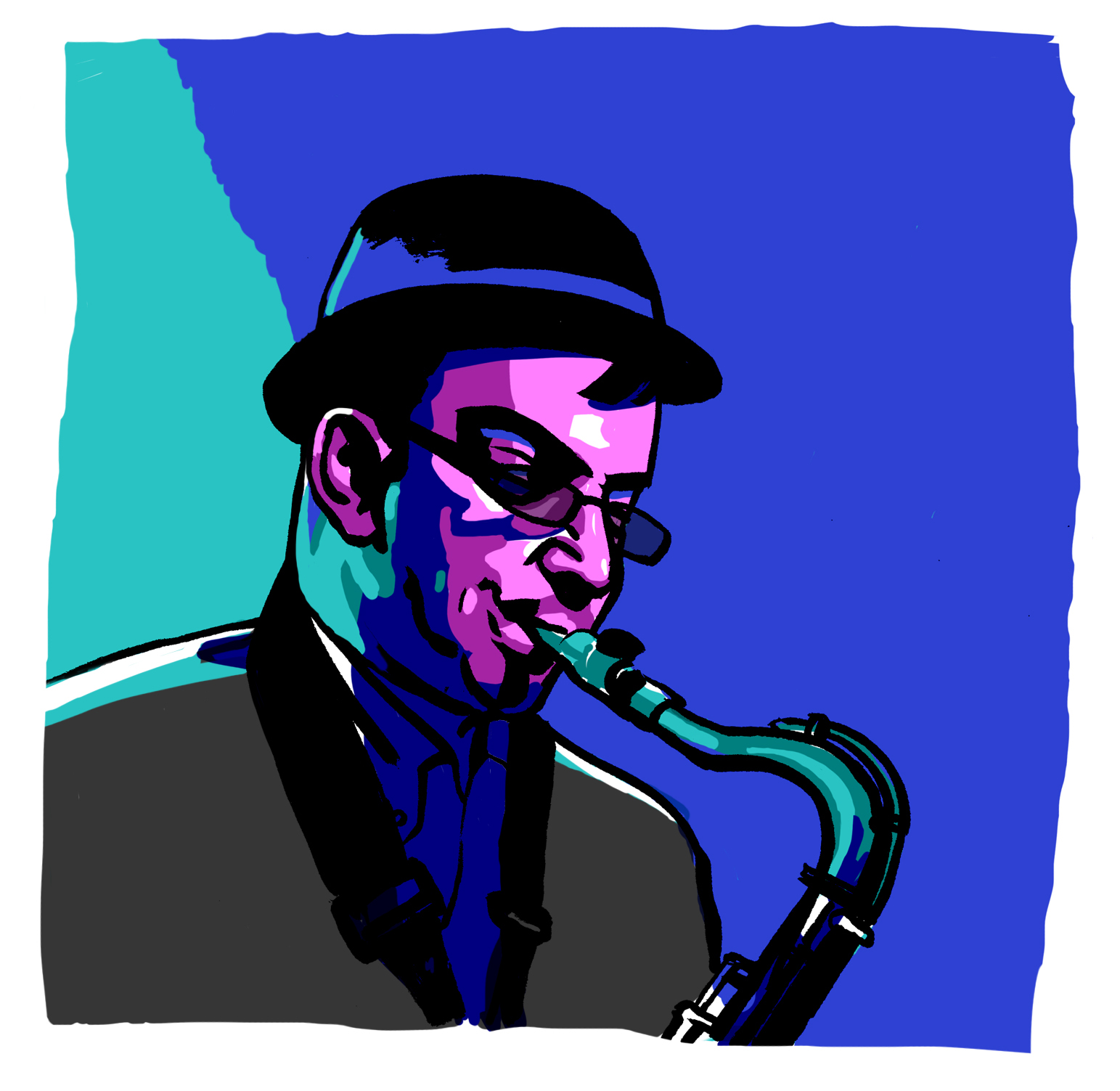
Simon D’souza: black suit, black trilby, shades. Soprano sax, tenor, alto, baritone, trumpet. He plays the sweetest soprano with us, just one of his bands. He also plays with the great big band, Straight No Chaser. He teaches jazz at Chichester College, and composes achingly beautiful music, in particular for his excellent band, Spirit. Once a year, regular as clockwork, he dominates the sax section in our Ska-Kestra, with his blistering storming tenor solos. God knows why he plays with us; well, he says it’s fun. He gives the lie to the taciturn po-faced jazz stereotype: this man is passionate, positive, funky, and… fun.

He recently had a brain tumour removed – he was airlifted from his French holiday to Hurstwood Park Neurosurgical Centre in Haywards Heath for the operation. His fellow musicians organise a benefit – a tribute to him, and a fund-raiser for the Friends of the hospital. The gig is called Spirit of Love (‘I was on pharmaceutical drugs when I came up with the name’). The Brunswick is packed with friends and jazz fans: no-one can enter unless someone goes out – it’s at capacity; a huge cheer goes up when he and Susan enter: Simon affects surprise (but it’s actually delight) at seeing so many people.

Saxshop, Simon’s 19-piece band (16 of them are horns) makes a massive sound in the small venue. They play arrangements of The Pink Panther, One Step Beyond, Night Train (that’s one of ours struck off the set-list, then!) and more. Simon’s nodding and smiling his approval. After them come Spirit – trumpet, tenor, trombone, piano bass and drums. Lush, moving compositions, heartfelt solos over exquisite rhythm section playing, can bring tears to your eyes. Follow that!

Ska Toons have been asked to wrap up the evening, and we’re expecting an exodus of jazz fans: except they stay. Simon doesn’t though (with apologies) and he has – let’s face it – heard and played our stuff many times. It still takes him ages to get to the door, as he’s stopped and hugged by friends and well-wishers. We blast through our 50 minutes at full-pelt, and though he’s not on stage with us, Simon’s spirit fires our playing.

‘So ‘carpe diem’, no more pissing around with computer games for me!  I am going to live whatever life is left me to the full.  Expect to see me out playing gigs in the near future!’

Consummate musician, composer, arranger, teacher, and a thoroughly nice man. An inspiration.

http://www.souzamusic.co.uk/music.html
http://www.justgiving.com/spiritoflove